You’ve probably landed on this page because you’ve created some top-drawer ad copy. People are clicking, but you aren’t getting any meaningful action or conversions. You’ve run into one of two problems. Either your targeting is awful, and the people clicking on your ads aren’t your audience. Or, more likely, your landing page is horrifically irrelevant, and people are bouncing.
Don’t worry – we’ve compiled a list of the best paid ads landing pages, detailing what makes them great and how you can take inspiration from them to boost your own conversions.
By the end of this read, you’ll know why your paid ads landing pages suck right now and what you can do to fix the problem.
Your landing page is where all the money you’ve spent on ads either pays off—or disappears into thin air. You’ve paid to get users to click—now it’s up to the landing page to convince them to take action. If they land on a page that’s slow and doesn’t relate to the ad they clicked on, they’re gone in seconds, and so is your chance to convert them.
But when your landing page is on point, it’s like rolling out the red carpet. Visitors know they’re in the right place, and taking that next step feels easy. It’s the difference between making the most of your ad spend and wondering where it all went.
A recent A/B test study found that a dedicated landing page had 3x the conversions of a generic landing page, even though the ad had a lower click-through rate!

A Google Search for healthy coffee returned a sponsored result for Exhale. A U.K.-based company that specialises in organic and healthy coffee.
We love this and think it’s one of the best paid ads landing pages because Exhale has ticked all the right boxes.
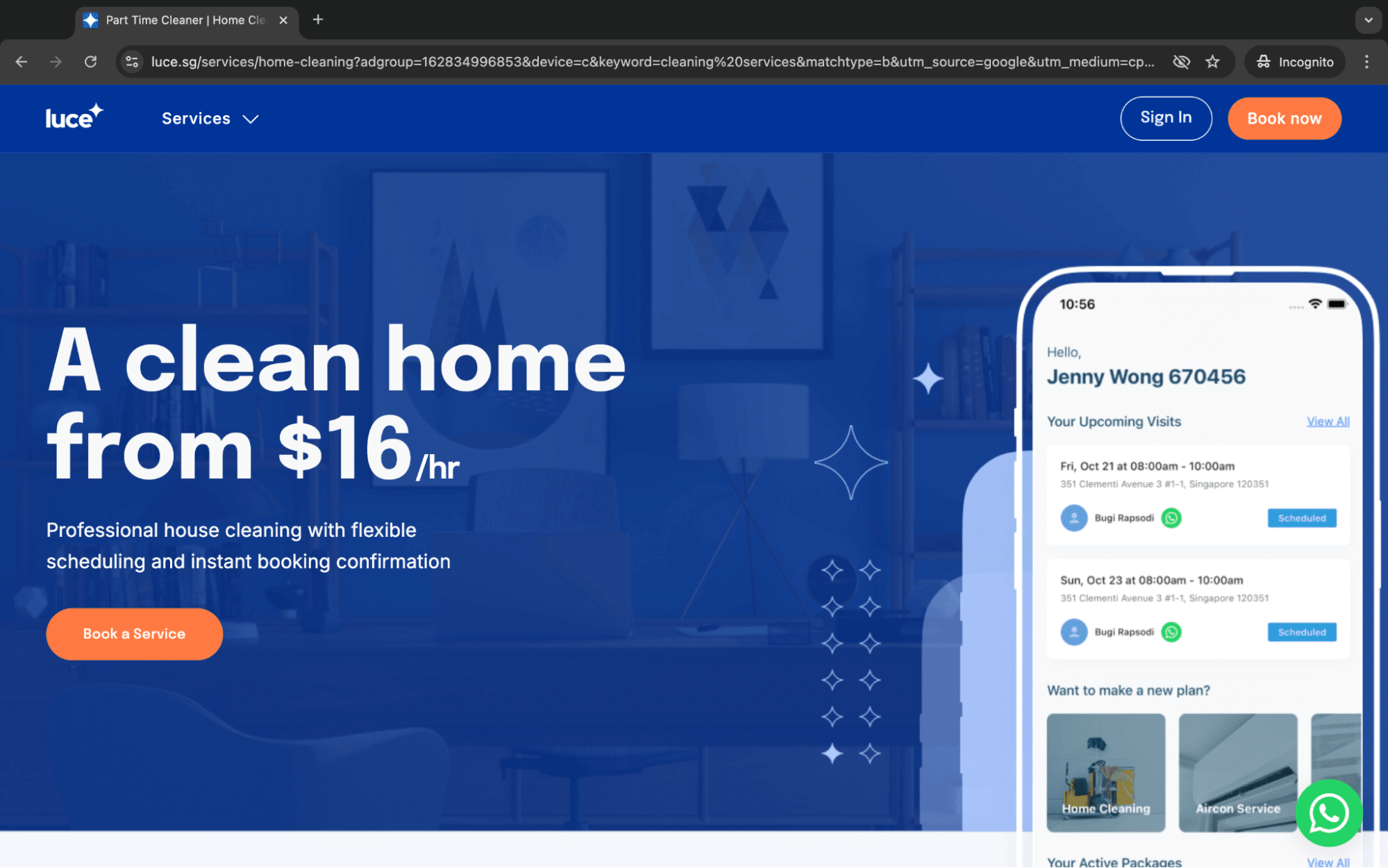
When we searched “home cleaning companies”, we found Luce and had to include them on our list of best-paid ads landing pages. Like Exhale, they follow a great Google Ads landing page design, but rather than focus on their brand, they let the benefits of their service take centre-stage and take more of a fact-based approach.
So, what makes this a good ad campaign landing page?

Orchard Scotts Dental (OSD) grabs attention right away with a bold, thought-provoking headline that makes the reader desire a confident smile. No fluff or distractions, just a clear solution: dental implants. A section on USPs bolster confidence, and another on FAQs helps clarify unasked questions. Information is backed up with credibility – Straumann and Neodent Implant Systems, which are highly regarded in the industry. OSD is also shown to be set apart from competitors. After the technicalities, readers are welcomed to a genteel introduction to the board of dental specialists, placing them at ease before guiding them toward booking an appointment. Simple, smart, and built to salve any pain points before conversion.

The team over at Floof have a very engaging and in-your-face Google ads landing page design. We went looking for “natural dog food” and their page instantly caught our attention.

Nutrition Kitchen brands themselves as Meal Plans for Busy People. This message carries over from their ad and into their messaging. What we like about their landing page is they immediately deliver their benefits, and how it works for their target audience, and they use visuals of tasty-looking food to demonstrate they cater to all different dietary requirements.
The entire meal planning process is explained simply, and they carry a consistent CTA with an introductory saving.
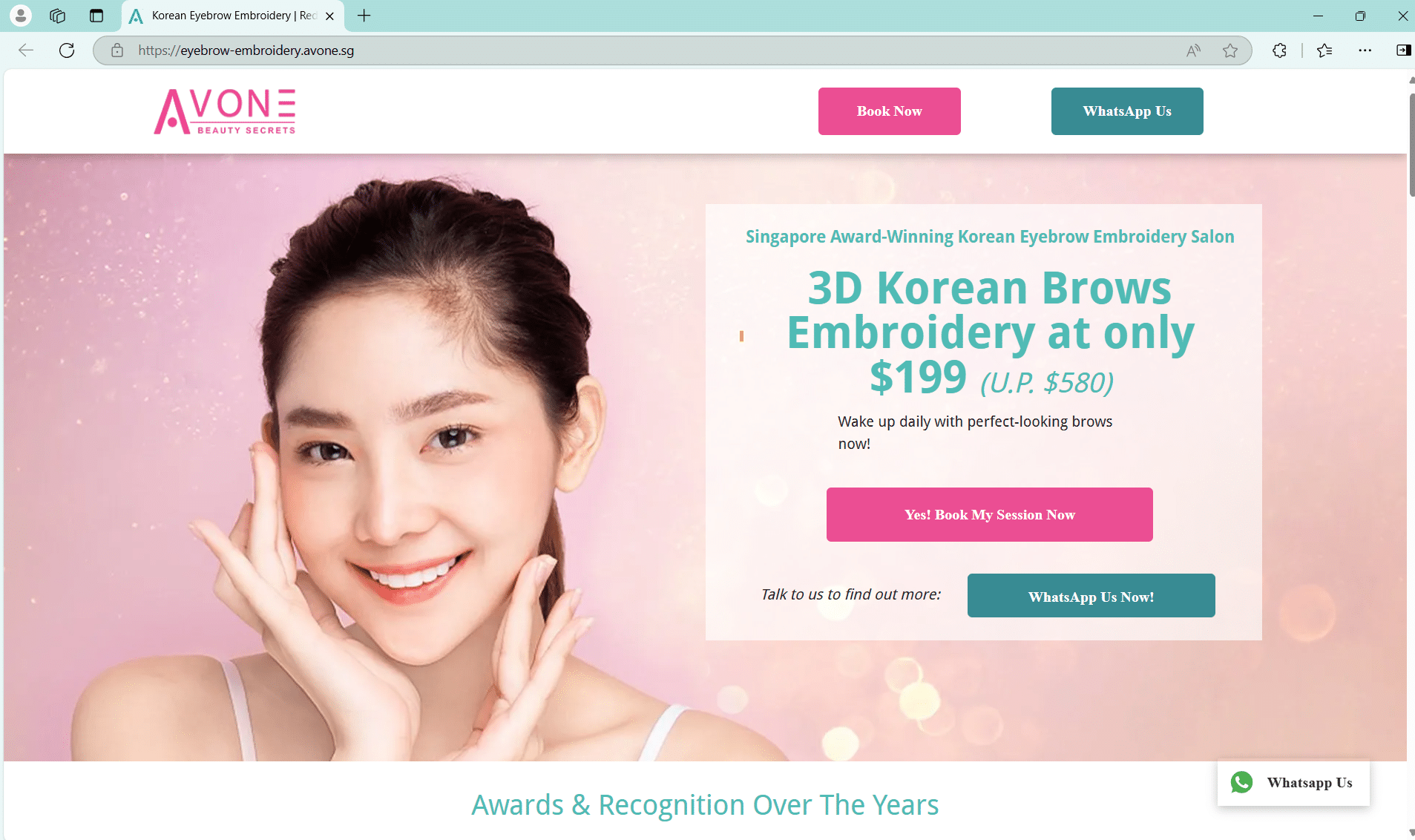
The AVONE landing page is perfectly framed with an irresistible hook. Perfect for first-timers new to eyebrow embroidery, and existing customers who’ll definitely be curious about the latest bladeless technique requiring no downtime. Rave reviews by top influencers pull readers in. The real showstopper? AVONE is the only brand in Singapore with several embroidery techniques accredited by the International Beauty and Health General Union of Korea. That’s credibility that can hasten readers toward a booking. For anyone still on the fence, a simple video demonstrates their ultra-gentle technique on a balloon, sealing the deal. The message is clear, now all that’s left to do is book an appointment.
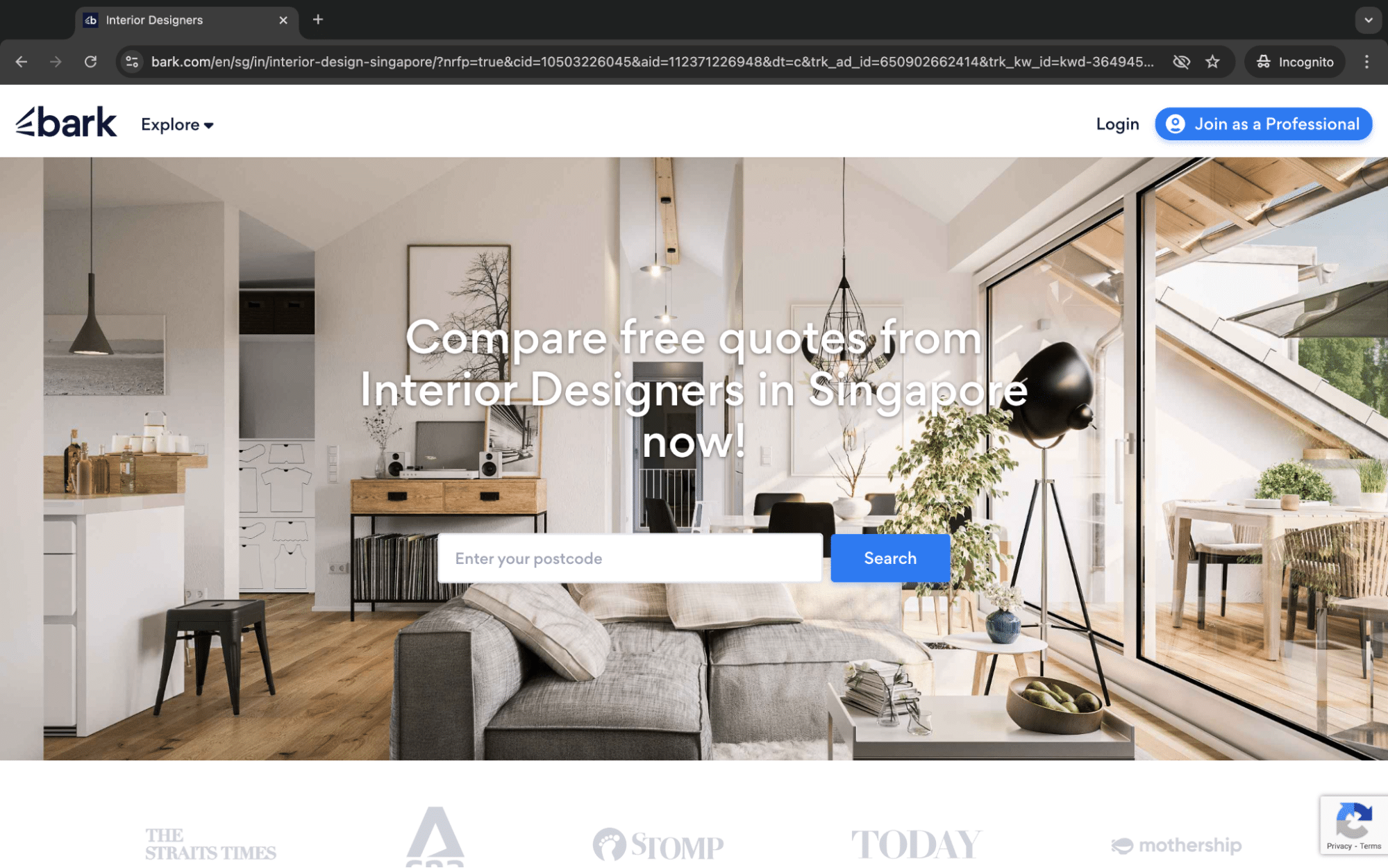
This is easily the simplest of our ad campaign landing page examples. A search for “interior design services” brings up Bark, a directory for different services. This landing page prompts you to put in your postcode, and it will list all of the best interior designers in your area. Simple and effective.
It gets right to the point. You don’t need to know about Bark, you don’t need to know about how it works – yet, you just want to find interior designers and they make it easy.

At Polaris Plastic Surgery, the quest for double eyelids begins with the end result. It shows readers exactly what they came for: real double eyelids results. The landing page keeps things engaging with many points, supported by cosmetic solutions tailored to specific needs. It speaks directly to common vanity concerns, from wanting to look and feel more confident. Readers get a clear breakdown of different techniques, what to expect, and answers to common questions. A certified introduction to the surgeon makes it easier to take the next step, booking a consultation with the team.

There’s nothing more annoying than seeing an ad that presents a promo, but then you click on the ad and the promo is nowhere to be seen or hidden away. DirectAsia does a great job of keeping messaging consistent with their current end-of-year promo.
Often, with car insurance, the thing that matters most to people is cost. Usually, we like to get a quote, find the cheapest, and then make sure it covers everything we need.
DirectAsia presents its offer in the header and follows it with the form you need to complete to get a quote. This gives users everything they need in the first two folds.
For those who need a bit more convincing, you can scroll to find out more about the company, but their current offers still remain a key theme and CTA.

The ad landing page example at Happy Paw Ark gets it right by speaking directly to pet parents’ daily concerns. It offers more than a fun day out for furkids. It also provides training that improves pet behaviour. Every detail indulges the need to spoil their furkids, and assuages their guilt for leaving their pets for work at the same time. There is a clear layout of membership perks, itineraries and customer testimonials that build trust. Every detail nudges pet parents to take action, making it easy to convert curiosity into a membership.
A good ad might get the click, but a great landing page closes the deal. Your landing page is where users decide if they’ll convert or bounce, so it needs to be designed with purpose. Here’s what every high-performing paid ads landing page needs to turn clicks into results:
Also Read: Landing Page Optimisations That Improves Conversion Rate
Your headline should grab attention immediately and make it obvious what the page is about. It’s the first thing visitors see, so keep it concise, benefit-driven, and aligned with your ad. Make sure it is relevant to the ad people clicked on!
A large chunk of your traffic will come from mobile devices, especially if you’re using paid social ads, so your landing page must be responsive. The text should be easy to read, buttons should be tappable, and forms should be simple to fill out on smaller screens.
Your landing page should focus on a single conversion goal—whether it’s signing up, making a purchase, or downloading a resource. The CTA should be prominent, action-oriented, and repeated strategically throughout the page. Too many CTAs distract from the purpose of the page and overwhelm the user.
Most people need some kind of social proof before making a purchase. Add customer testimonials, reviews, trust badges, or data points to reassure visitors they’re making the right choice. Anything that addresses scepticism can help boost conversions.
The content on your landing page should match the promise made in your ad. If your ad promotes “50% off for first-time customers,” the landing page should immediately deliver on that offer. Misaligned content leads to bounces and lost trust.
Make it easy for users to convert. Too many roadblocks or asking for too much information can turn people off instantly. Keep it short and sweet. Only ask for essential information, and make the process as seamless as possible. You don’t need to know their Grandma’s dog's name.
Managing Google Ads and other PPC platforms is a full-time job. It involves doing keyword research, writing killer ad copy, optimising your campaigns, creating dedicated landing pages, managing budgets, and that’s just the tip of the iceberg.
When done correctly, PPC can be a consistent revenue stream with exceptional ROI, but you have to dedicate time to it. Our PPC team has helped businesses create some of the best paid ads landing pages and campaigns for companies in Singapore. Get in touch today to discuss your requirements and get a free proposal.
Cost per lead (CPL). Just hearing the term probably makes you brace for spreadsheets, charts, and a flood of marketing jargon.
Maybe you’ve tried to figure it out before. You stare at your Google Ads dashboard, crunch a few numbers, and end up wondering if your campaigns are doing well or if you’re just burning cash. Then you Google “average CPL”, get hit with pages of vague advice, and eventually give up, promising yourself you’ll look into it later.
Sound familiar?
Understanding CPL can feel like decoding ancient texts, but it doesn’t have to. It’s one of the most practical ways to know if your ad budget is working or if something needs to change. With a clear idea of the average cost per lead, you can set better goals, make smarter decisions, and stop wasting money on campaigns that don’t deliver.
The average cost per lead (CPL) tells you how much you’re spending to get a potential customer to show interest in your business. A lead could be someone filling out a form, signing up for a service, or making an enquiry—essentially any action that indicates they’re considering what you offer.
Calculating CPL is straightforward: divide the total amount spent on a campaign by the number of leads it generates. For example, if you spent SGD 1,000 on Google Ads and brought in 100 leads, your CPL would be SGD 10. Basically, it gives you a clear sense of how effectively your advertising budget is working.
By understanding your CPL, you can gauge whether the cost aligns with the quality of the leads you’re attracting and the revenue they bring in. It’s a practical way to measure how well your marketing efforts are converting interest into opportunities, which helps refine your approach and improve your return on investment.
More than 80% of businesses use Google Ads, but chances are most of them aren’t paying close attention to CPL averages. Understanding your industry’s average cost per lead (CPL) gives you the context to make better decisions about your marketing efforts. Without benchmarks, it’s hard to know if you’re overspending or underperforming. A CPL that’s far above the industry average might mean your campaigns aren’t as efficient as they could be, while a much lower CPL might seem great on the surface but could signal you’re not reaching high-quality, qualified leads.
If you’re paying more than others in your industry, it’s worth digging into what could be holding your campaigns back. You can use CPL averages to highlight opportunities for improvement. It might be targeting that’s too broad, ad content that isn’t resonating, or landing pages that don’t encourage conversions. On the flip side, benchmarks can confirm when your CPL aligns with industry standards, giving you confidence to double down on what’s working well.
Ultimately, knowing your CPL benchmark helps you stay competitive. It’s a way to measure your performance against others in your space and adapt your strategy when needed.
This is incredibly obvious, and industries with high competition - like aesthetics and wellness - tend to have higher CPLs because multiple businesses are competing for the same audience. This drives up the cost of the ad auction, especially for popular keywords.
CPL is also shaped by the quality of leads you attract. High-quality leads, though often more expensive to acquire, are more likely to convert into customers. Industries with narrower or more specific audiences typically see higher CPLs because of the precision required to target the right leads. For example, a more bespoke service that charges more will naturally have a higher CPL compared to a business that targets a more mass market.
Also Read: Landing Page Optimisations That Improves Conversion Rate
Businesses with high-value clients, like medical specialists or B2B services, can afford higher CPLs because the potential revenue from each lead justifies the cost. In contrast, industries like home products or services often have lower CPLs due to smaller transaction sizes.
There are so many acronyms in digital marketing, but you really do need to know the difference and relationship between CPC and CPL.
So, CPC (Cost Per Click) is what you pay every time someone clicks on your ad. CPL (Cost Per Lead), on the other hand, is what you’re spending to actually get someone’s contact details, interest, or whatever you count as a lead.
A good way to think of it is CPC is the cost to open the door, while CPL is the cost to get someone to sit down and chat. Both matter because clicks don’t pay the bills—leads (and ultimately sales) do.
So, we’ve established that CPC measures how much you’re paying for each click on your ad, while CPL tells you what it costs to turn those clicks into leads. However, understanding how they work together is where you can really identify where if your money is being spent effectively—or not.
If your CPC is high, your CPL will naturally increase unless your landing page converts clicks into leads at an impressive rate.
For example, if your CPC is $2 and you need 10 clicks to generate a lead, your CPL will be $20. Lowering your CPC to $1.50 would reduce your CPL to $15 if your conversion rate stays the same.
But you can’t rely solely on reducing CPC, especially if your landing page or form isn’t converting clicks into leads, even the cheapest CPC will result in a high CPL.
For instance, if it takes 20 clicks to get one lead instead of 10, your CPL doubles—regardless of how cheap those clicks are.
By tracking both CPC and CPL, you can spot what’s driving up costs. Whether it’s the ad targeting, landing page design, or something else, knowing these numbers helps you decide what to adjust.
The following cost-per-click (CPC) benchmarks are based on data from client campaigns we managed in Singapore throughout 2024. These figures reflect the average performance across key industries, using primary data from real-world accounts. If you’re new to Google Ads or are analyzing current performance, these numbers can help you decide how much budget you might need.
Aesthetics Sector: $3.44
High demand for treatments like Botox, fillers, and skin rejuvenation drives competition, pushing up CPC. Customers in this market often take time to compare options, which also impacts costs.
Wellness Sector: $3.08
Businesses such as yoga studios, spas, and fitness centers have a slightly broader audience than aesthetics, resulting in a moderately lower CPC. Competition remains strong, but with less niche focus.
Medical Specialists: $2.66
Niche services like cardiology or dermatology benefit from more focused audience targeting. Patients searching for specialized care tend to perform deliberate, high-intent searches, leading to a mid-range CPC.
B2B: $2.26
B2B leads typically involve complex decision-making processes and multiple stakeholders. While CPC is lower than some industries, the longer nurturing cycles for these leads make them equally valuable.
Dental: $1.37
Searches for dental services are often localized and highly intent-driven (e.g., "dentist near me"). Lower competition and specific targeting keep the CPC for this sector relatively low.
Refining your audience targeting is one of the most effective ways to reduce your CPL. Broad targeting might attract clicks, but many of them won’t turn into leads, wasting your budget. Focus on specific demographics, locations, and interests that match your ideal customer profile. For example, a fitness business who wants to grow its number of female members might target people within women, within a particular age group who have shown interest in wellness and exercise.

Negative keywords help prevent your ads from appearing in irrelevant searches. For example, if you’re running ads for premium beauty treatments, you wouldn’t want your ads showing up for searches like “cheap beauty treatments” or “home beauty kits.” Adding these irrelevant terms as negative keywords will stop your ads only appearing for them, and they’ll be shown to people more likely to be interested in your services, making every click more valuable.
Also Read: The Ultimate Beginner's Guide to PPC Keyword Research
Ads that speak directly to your audience’s needs tend to perform better and cost less. Write clear, compelling headlines, include visuals that grab attention, and make your call-to-action specific. For example, instead of saying “Contact us,” a more actionable CTA like “Book your free consultation” works better. Regularly testing different versions of your ads helps you find what resonates most with your audience, keeping performance strong over time.
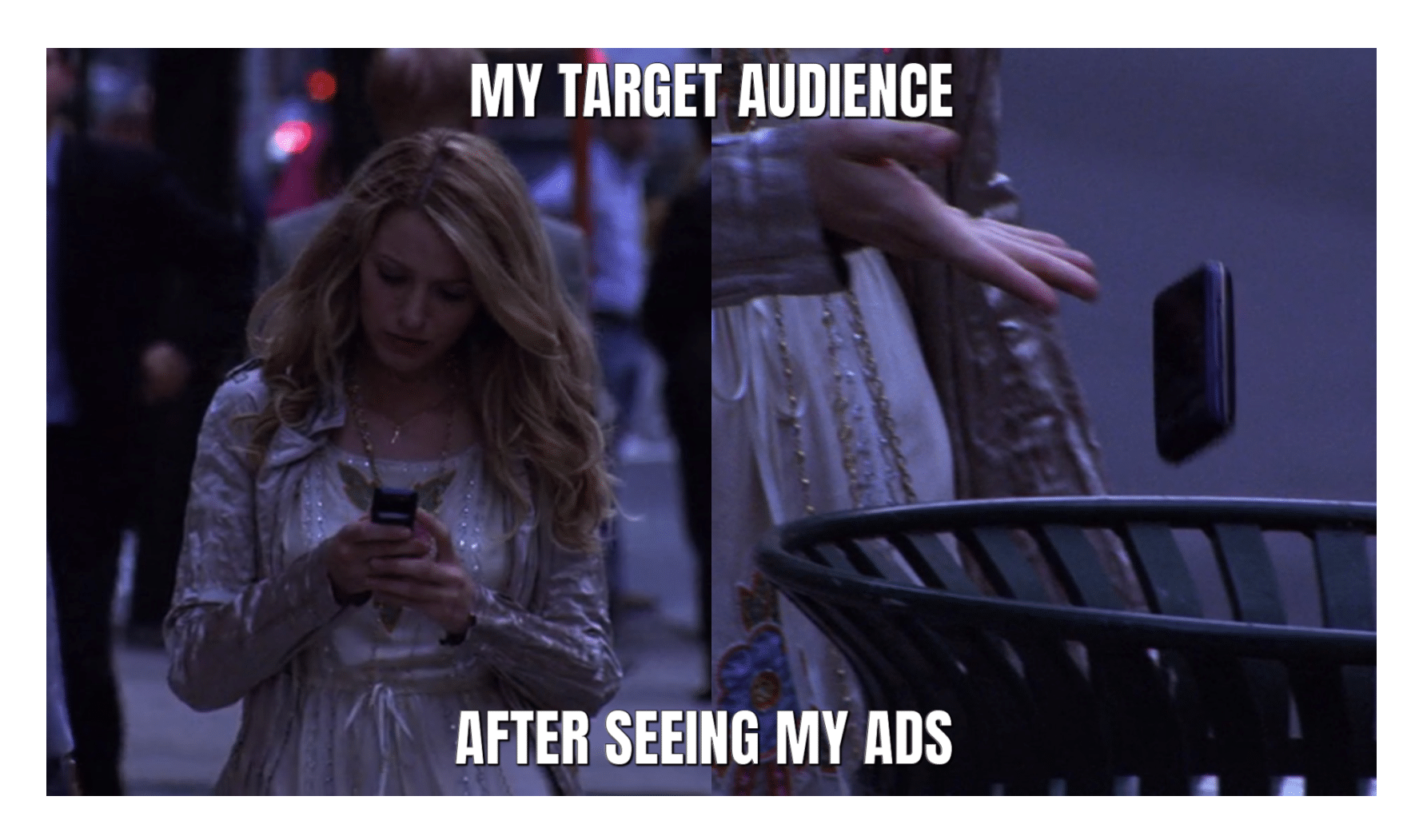
Bad ad copy = …
Once someone clicks on your ad, the next step is turning that visit into a lead (conversion). A slow or confusing landing page can lose potential customers in seconds. Interestingly, only 10-15% of leads become customers, and a landing page is crucial in that process. Your landing page should match the ad’s promise and make it easy for visitors to take action, whether that’s booking an appointment or downloading a guide. Keep the layout simple, ensure the page loads quickly, and feature a prominent call-to-action to keep visitors focused.

Regularly reviewing your campaigns helps you identify what’s working and what’s not. Check for high-cost keywords that aren’t delivering results or ads with low click-through rates. Adjust your budget toward campaigns that are generating leads efficiently, and pause or tweak any that aren’t performing. Making small, regular adjustments ensures your campaigns stay cost-effective and aligned with your goals.
Google Ads uses a pay-per-click (PPC) model, meaning you’re only charged when someone clicks on your ad. The price you pay for each click is determined by an auction system where you bid on specific keywords. However, it’s purely based on who bids the most—Google considers your ad’s Quality Score, which is influenced by factors like ad relevance, click-through rate, and landing page experience.
Ads with higher relevance and better Quality Scores often pay less per click, even if their bid is lower than a competitor’s. Basically, you’re encouraged to focus on creating ads and landing pages that are relevant to the keywords you’re bidding on and what users are looking for.
The cost of Google Ads is influenced by three main factors: keyword competition, Quality Score, and bid amount.
Google Ads and other PPC platforms let you set a daily budget, but spending isn’t always evenly distributed. Google may allocate more budget during high-traffic periods and even exceed your daily limit on busy days, balancing it out over the month.
You can choose Standard Delivery to spread spending across the day or Accelerated Delivery to use your budget more quickly. Costs are incurred only when someone interacts with your ad, giving you control over how your budget is used.
PPC isn’t easy to master. It’s a pay-to-play channel best optimized by experts. Get in touch with Heroes of Digital today to discuss your Google Ads and PPC goals. You’ll get a free, no obligation proposal when you do!




Get A Free Proposal